Citizenship by Residency; Understanding the Spanish Civil Code.
When navigating the path to Spanish nationality by residency, you will frequently encounter references to the Spanish Civil Code.
In this guide, we will break down the exact articles that govern how to obtain Spanish nationality through residence.
The Concession of Nationality:
The journey begins through understanding the Civil Code which contains an article establishes a mechanism through which nationality is granted.
The “Carta de Naturaleza” (a discretionary grant by Royal Decree for exceptional circumstances), and states that Spanish nationality is acquired by residence through a concession granted by the Minister of Justice .
This is an important distinction: it is not an automatic right even if you meet the time requirements. The Minister has the authority to grant or deny the application based on reasoned grounds, typically related to public order or national interest, after verifying that all legal requirements are met . This is why building a strong, well-documented application is essential.
The Heart of the Matter—Residency Periods:
The Civil Code is the core legal text that determines how long you must have lived in Spain before you can apply for citizenship . It specifies that the residency must be legal, continuous, and immediately prior to the application .
Here are the residency periods required according the Spanish civil code:
- 10 Years (General Rule): This is the standard period for most foreign nationals residing in Spain .
- 5 Years: This reduced period applies to individuals who have been granted refugee status .
- 2 Years: A significant reduction for nationals of countries with special historical ties to Spain. This includes:
- Ibero-American countries (including all of Latin America, Spain’s historical community of nations)
- Andorra
- The Philippines
- Equatorial Guinea
- Portugal
- Individuals of Sephardic origin
- 1 Year: This shortest period applies in several specific circumstances, such as:
- Those born in Spanish territory.
- Individuals who have been legally married to a Spanish citizen for one year (and are not legally or de facto separated).
- The widow or widower of a Spanish citizen, provided they were not separated at the time of death.
- Those who were born outside Spain but whose parent, grandparent, or grandchild was originally Spanish .
Integration Requirements (CCSE and DELE):
It is not enough to simply live in Spain for the required number of years. The civil code mandates that the applicant must demonstrate good civic conduct and a sufficient degree of integration into Spanish society .
For most applicants, this integration is proven by passing two official exams administered by the Instituto Cervantes:
- The CCSE Exam (Constitutional and Sociocultural Knowledge): This test evaluates your knowledge of the Spanish Constitution, as well as the social and cultural reality of Spain. It is a requirement for almost all applicants .
- The DELE Exam (Diploma of Spanish as a Foreign Language): You must prove a minimum language proficiency of Level A2 or higher. This is mandatory for applicants from countries where Spanish is not the official language .
Note: There are some exceptions, such as for citizens from Spanish-speaking countries or those who have completed compulsory education in Spain .
Summary of the Process
In short, the path to Spanish nationality by residency is governed by the Civil Code. You must first complete the required legal residency period (which ranges from 1 to 10 years depending on your personal situation). Once the time requirement is met, you must demonstrate your integration by passing the CCSE and DELE exams and provide evidence of good conduct.
*Are you unsure if your country of origin qualifies you for the reduced 2-year residency period? Contact us for a personalized assessment of your eligibility; Schedule an appointment with a solicitor »
Other types of residency available in Spain:
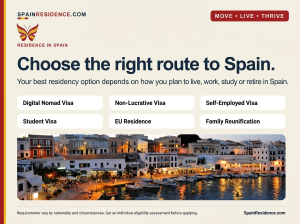
- Digital-Nomad visa Spain (Remote worker in Spain)
- Non-Lucrative Visa Spain (Spanish visa non lucrative)
- Student-Visa Permit (Student-Visa & up-to 30 hours work per week)
- Self-Employed Visa Spain (Self employed expats in Spain)
- All Visa-Categories in Spain (SEE-ALL here; Arraigo, Special Cases, etc.)
Immigration procedures and immigration regulations change regularly, and it is crucial to stay updated with the most recent information from a reliable source. If you have any questions or concerns about your situation, we advise to consult an immigration authority or legal professional who specializes in immigration matters, to do this, please CLICK-HERE »
We offer Spanish Residence Services and can assist you with most Spanish legal processes.
Permanent residency is permitted after 5 years of Temporary Spanish Residency through Digital-Nomad, Non-Lucrative, Student-Visa or Self-Employed. This followed by 5 years of permanent residency in Spain and permits Spanish Citizenship applications to obtain a Spanish Passport.