New Immigration Updates from Spain’s Ministry of Inclusion, Social Security and Migrations
Keeping you informed about the latest developments in Spanish immigration law.
These updates reflect Spain’s ongoing commitment to streamlining and clarifying its immigration processes. Whether you’re applying for residency, renewing a permit, or seeking to regularize your status, staying informed about these management criteria is crucial.
Key Management Criteria Published (September 2025):
The Directorate General for Migratory Management has issued several important criteria that clarify how immigration applications are assessed:
1. Prohibition of Double Assessment (Criterio 1/2025)
Published on 17 September 2025, this criterion addresses the interdiction of double assessment, ensuring that applicants are not penalized twice for the same circumstances during the evaluation of their immigration files.
2. Medical Certificate No Longer Required in Certain Cases (Criterio 5/2025)
Published on 16 September 2025, this update confirms that the medical certificate is no longer required for long-term stay or residence authorizations when the foreign national is already in Spain. This represents a significant simplification for many applicants.
3. Expanded Criteria on Time Spent in Irregular Situation for International Protection Applicants (Arraigo)
Also published on 16 September 2025, this ampliatory criterion clarifies how time spent in an irregular situation by applicants for international protection is counted when applying for arraigo (settlement) permits. This is particularly relevant for those seeking to regularize their status through social or labor ties to Spain.
Public Consultation: Electronic Registry of Immigration Collaborators:
The Ministry has opened a public consultation (running until 20 September 2025) regarding a new Ministerial Order that will create and regulate the Electronic Registry of Immigration Collaborators.
This registry aims to formalize the role of organizations and entities that assist immigrants with their administrative procedures. If you represent an organization working in the immigration sector, this is your opportunity to contribute your views and suggestions before the regulation is finalized.
Update on Arraigo: Counting Time in Irregular Situation (August 2025):
Published on 28 August 2025, Criterio de Gestión 4/2025 provides further clarification on how time spent in an irregular situation by international protection applicants is computed for the purposes of applying for arraigo. This continues the Ministry’s efforts to harmonize the application of the new Immigration Regulation (RD 1155/2024).
Renewals for Minors Born and Not Born in Spain (July 2025):
A management criterion published on 3 July 2025 addresses the renewal of authorizations under the old RLOEX (RD 1155/2024) for minors, whether born in Spain or abroad. This provides much-needed clarity for families navigating the transition to the new regulatory framework.
Registration of Marriages Celebrated Abroad (July 2025):
If you married outside Spain, be aware that the Ministry has published criteria (1 July 2025) regarding the obligation to register your marriage in the Spanish Civil Registry. This is a crucial step for many immigration procedures, including family reunification and residency applications.
New Rules for Employers Requesting Residency and Work Authorizations (June 2025):
Published on 25 June 2025, this criterion clarifies the legitimacy of employers and companies to apply for residency and work authorizations under the new RLOEX (RD 1155/2024). If you’re an employer looking to hire non-EU talent, understanding this criterion is essential.
Social Security Number and Registration for Foreign Nationals (June 2025):
A note published on 24 June 2025 confirms that foreign nationals applying under the transitional regime of the new Immigration Regulation can be assigned a Social Security Number (NUSS) and registered with Social Security, even if their initial authorization was requested under the previous regulation that did not include the right to work.
Fee Payment Postponement for Immigration Procedures (May 2025):
The entry into force of the new Immigration Regulation brought with it changes to the fee system. A note published on 20 May 2025 announced a temporary block on fee payments (forms 052 and 062) for certain procedures, allowing applicants to pay within 10 business days following the publication of the new fee schedule in the Official State Gazette (BOE).
Venezuelan Passports: Expired Documents Now Accepted (January 2025):
In a welcome development for Venezuelan nationals, a joint instruction published on 14 January 2025 reinstates the acceptance of expired Venezuelan passports for immigration procedures, including the issuance and delivery of the Foreigner Identity Card (TIE). This recognizes the ongoing difficulties many Venezuelans face in renewing their passports through consular offices in Spain.
What This Means for You
At SpainResidence.com, we specialize in helping individuals and families navigate the Spanish immigration system with confidence. If you have questions about how these updates might affect your particular situation, don’t hesitate to reach out to our team of experts.
Stay tuned for more updates as we continue to monitor developments from the Ministry of Inclusion, Social Security and Migrations.
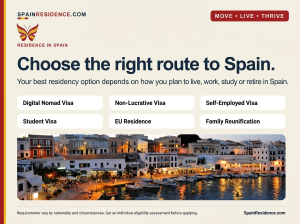
To obtain residence in Spain, choose your preferred residence from the list of residencies available in Spain below:
- Digital-Nomad visa
- Non-Lucrative visa
- Student-Visa Permit (Student-Visa permits up-to 30 hours work per week)
- Self-Employed Visa
- All Visa-Categories (Arraigo, Special Cases, etc.)
Immigration procedures and immigration regulations change regularly, and it is crucial to stay updated with the most recent information from a reliable source. If you have any questions or concerns about your situation, we advise to consult an immigration authority or legal professional who specializes in immigration matters.
Visit your preferred residence below:
We offer Spanish Residence Services and can assist you with most Spanish legal processes.
Permanent residency is permitted after 5 years of Temporary Spanish Residency through Digital-Nomad, Non-Lucrative, Student-Visa or Self-Employed. This followed by 5 years of permanent residency in Spain and permits Spanish Citizenship applications to obtain a Spanish Passport.