How to Get Residence in Spain in 2026: Your Options Explained.
Spain remains one of the most attractive places in Europe to live. It has a mild climate, excellent healthcare, a relaxed pace of life, and a strong international community. But anyone who has tried to work out the residence rules alone knows the process can feel like a maze of forms, consulates, and shifting regulations.
This guide covers the main routes to Spanish residence today, who each one suits, and where applicants most often go wrong.
First, an important update: the Golden Visa has ended.
If you’ve read older articles about buying a property in Spain to get residence, be aware that Spain’s Golden Visa for real estate investment was abolished in April 2025. Property purchase alone no longer qualifies you for residence.
That does not mean Spain is closed to non-EU nationals. Several other well-established routes remain, and for many people they are a better fit anyway.
1. The Non-Lucrative Visa: for those with passive income or savings.
Best for: retirees, remote investors, and anyone with independent means who doesn’t plan to work in Spain.
The Non-Lucrative Visa lets you live in Spain without working there, provided you can show sufficient financial resources, private health insurance with no co-payments, and a clean criminal record. It is initially granted for one year and can be renewed for two-year periods.
Where people go wrong: the financial evidence, the apostilled documents, and the sworn translations. A small inconsistency in your paperwork is one of the most common reasons for delay or refusal.
2. The Digital Nomad Visa: for remote workers.
Best for: freelancers and employees who work remotely for companies outside Spain.
Spain’s Digital Nomad Visa was designed for professionals who can work from anywhere. You must show that your work is carried out remotely, that you have a qualifying relationship with your clients or employer, and that your income meets the required threshold. It also offers access to a favourable tax regime for eligible applicants, which makes proper tax planning from day one very valuable.
Where people go wrong: documenting professional experience and the remote-work relationship properly, and misunderstanding the tax consequences of becoming a Spanish resident.
3. Work and entrepreneur routes: for professionals and business owners.
Best for: skilled professionals with a job offer, highly qualified workers, and founders starting a business.
Spain offers several work-based pathways, including highly qualified professional permits, employee permits, and the entrepreneur route for innovative projects. These typically involve more steps and a sponsoring employer or a business plan, so preparation matters.
4. Family reunification and EU family member cards.
Best for: spouses, partners, children, and in some cases parents of Spanish or EU citizens or legal residents.
If you have close family ties to someone who is a Spanish national, an EU citizen, or a legal resident of Spain, a family-based route may be the simplest and most secure option.
5. Arraigo: for those already living in Spain.
Best for: people who are already in Spain and have built genuine roots here.
The arraigo routes (social, work-based, family-based, and training-based) allow people who have lived in Spain for a qualifying period to regularise their status. Immigration regulations were reformed in 2025, so the requirements and timeframes differ from what many older guides describe. This is an area where current, professional advice makes a real difference.
Beyond the visa: residence, tax, and citizenship.
Getting your residence card is only the first step. Once you live in Spain more than 183 days a year, you are generally considered a tax resident, which affects your income tax, wealth tax, and reporting obligations on assets abroad. Planning this before you move can save significant money.
Residence is also the foundation for long-term goals:
- Permanent residence after five years of legal residence
- Spanish citizenship after the required period (ten years for most nationalities, less for some)
The most common mistakes we see.
- Choosing the wrong visa type. The right route depends on your income source, your plans, and your family situation, not on what worked for a friend.
- Incomplete or incorrectly legalised documents. Apostilles, translations, and validity dates are strictly checked.
- Weak financial evidence. Authorities want clear, consistent proof.
- Ignoring tax implications. Residence and tax status are closely linked.
- Following outdated advice. Immigration rules change often. A guide from two years ago may already be wrong.
- Applying alone, then having to start over. A refusal can cost months and make the next application harder.
How SpainResidence.com can help.
Applying for Spanish residence is not just paperwork. It is a series of decisions, and each one affects your timeline, your costs, and your chances of approval. Our team can help you with:
- Assessing your situation and identifying the best residence route for you
- Preparing and reviewing your documents so your file is complete and consistent
- Submitting your application and following it through to resolution
- Coordinating the practical steps after approval, such as NIE, TIE card, registration, and more
- Connecting you with trusted tax, legal, and property professionals for the wider picture
We work with clients from around the world and guide them from first question to final approval, clearly and without surprises.
Ready to start your Spanish chapter?
Every case is different. Whether you’re a retiree dreaming of the coast, a remote worker looking for a better lifestyle, or a family planning a long-term move, the first step is a conversation.
Contact SpainResidence.com today to book a consultation, and let us help you find the right path to residence in Spain.
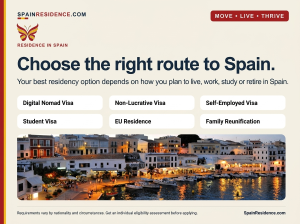
Choose your preferred residence from the list of residencies available in Spain below:
- Digital-Nomad visa
- Non-Lucrative visa
- Student-Visa Permit (Student-Visa permits up-to 30 hours work per week)
- Self-Employed Visa
- All Visa-Categories (Arraigo, Special Cases, etc.)
Immigration procedures and immigration regulations change regularly, and it is crucial to stay updated with the most recent information from a reliable source. If you have any questions or concerns about your situation, we advise to consult an immigration authority or legal professional who specializes in immigration matters.
Visit your preferred residence below:
We offer Spanish Residence Services and can assist you with most Spanish legal processes.
Permanent residency is permitted after 5 years of Temporary Spanish Residency through Digital-Nomad, Non-Lucrative, Student-Visa or Self-Employed. This followed by 5 years of permanent residency in Spain and permits Spanish Citizenship applications to obtain a Spanish Passport.