Complete guide for obtaining Spanish residence in 2026
Spain remains one of Europe’s most attractive destinations for expats, remote workers, retirees, and investors. With new immigration reforms introduced in May 2025, pathways to residency are now more accessible than ever. This guide covers everything you need to know about obtaining legal residency in Spain this year.
Essential First Steps:
Before you can live legally in Spain, you will need two fundamental documents: your NIE and your TIE.
Your NIE (Número de Identificación de Extranjero) is a foreigner identification number required for almost any official procedure, including buying property or signing an employment contract. To get one, you will need to book a “cita previa” with the National Police, fill out the EX-15 form, pay the Modelo 790 Código 012 fee, and bring your passport along with proof of why you need the NIE.
The TIE (Tarjeta de Identidad de Extranjero) is the physical residence card that proves your legal status in Spain.
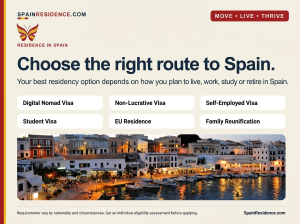
The Five Main Residency Routes in 2026:
1. Non-Lucrative Visa (NLV)
Best for: Retirees and those with passive income (pensions, rental income, or savings).
The Non-Lucrative Visa allows you to reside in Spain without working locally. The key requirement is proving sufficient economic solvency: for 2025, you must show at least €2,400 per month (400% of the IPREM) for the main applicant, plus an additional €600 per month for each dependent family member. You will also need comprehensive private health insurance with full coverage and no co-payments, a clean criminal record, and proof of accommodation in Spain. The initial permit is valid for one year, renewable for two-year periods, and counts toward permanent residency after five years.
2. Digital Nomad Visa (DNV)
Best for: Remote workers and freelancers working for companies or clients outside Spain.
This visa is designed for non-EU nationals who can work remotely. You must show at least €2,760 per month in income, and 80% of your income must come from clients or an employer located outside Spain. Your employer or company must have been operational for at least one year, and you need either a university degree or three years of relevant work experience in your field. The visa allows you to live and work in Spain for up to five years. The application process can be completed either from your home country or, in some cases, after entering Spain as a tourist.
3. Work Visa (General Regime)
Best for: Those with a confirmed job offer from a Spanish employer.
This route requires a formal job offer from a Spanish company that is willing to sponsor your work permit. Your salary must meet at least the minimum interprofessional wage (€1,184 per month). Required documents include a signed employment contract, the EX-03 form filled out by your employer, a clean criminal record certificate from your countries of residence, and a medical certificate. The permit is typically issued for a one-year initial period with opportunities for renewal.
4. Student Visa
Best for: Those seeking to study at a recognised Spanish institution with a pathway to work residency.
The Student Visa remains one of the easiest initial routes to enter Spain. Under the 2025 reforms, students pursuing formal degrees receive a residence permit covering their entire study period (for example, two years for a master’s program) instead of needing to renew annually. While you can work part-time (up to 30 hours per week) while studying, you must later convert your student status to a work permit after graduation to remain legally. After three years as a student, you may modify your status to a work or self-employment residence permit.
5. Self-Employed Entrepreneur Visa
Best for: Business founders launching innovative projects in Spain.
This visa is for non-EU nationals who want to start a business in Spain. You will need a viable business plan and a favourable report from ENISA (the state-owned innovation advisory company). You must demonstrate sufficient financial resources to launch and sustain your business. The application process involves submitting your business plan to ENISA, obtaining a favorable report, and then applying for the residence permit either from abroad or while in Spain.
The General Step-by-Step Process:
Regardless of which visa you choose, the application process follows a similar structure.
1. Gather your documents
Collect all required paperwork. Foreign documents must generally be apostilled under the Hague Convention and translated into Spanish by a sworn translator (traductor jurado). Standard documents include a valid passport (with at least two blank pages), recent photographs, the appropriate application form (EX-01 for NLV, EX-03 for work visas, or national visa forms), proof of financial means (bank statements, pension letters, or investment portfolios), comprehensive health insurance from a Spanish provider, a clean criminal record certificate from any country where you have lived in the last five years, and a medical certificate stating you are free of infectious diseases.
2. Apply for the visa
If you are outside Spain, you will submit your application at the Spanish consulate in your home country. If you are already legally in Spain, some permits (such as certain arraigo options) can be applied for directly through immigration offices.
Disclaimer: As each applicant’s situation is unique, requirements may vary. We strongly recommend consulting with a Spanish immigration service to tailor the process to your specific circumstances.
3. Receive the visa and enter Spain
Once approved, you will have a limited period (usually three months) to enter Spain.
4. Apply for your TIE
Within 30 days of arrival, book a police appointment for fingerprinting and submit your TIE application.
5. Register on the “padrón”
Register with your local town hall (empadronamiento) within three months of arrival to certify your address.
Additional Pathways for Those Already in Spain:
Arraigo (Rooting) Permits – May 2025 Update
If you are already living in Spain without papers, the 2025 immigration reform has expanded the “arraigo” (rooting) options significantly.
Social Arraigo: For those who have lived continuously in Spain for at least two years and can demonstrate social integration within their community. Absences cannot exceed 120 days total across the two-year period.
Labour Arraigo: For those who have worked for at least six months in Spain while residing in the country for two years.
Arraigo Socio-laboral: For those with two years of residence who can present part-time job contracts totalling at least 20 hours per week.
Family Reunification
If you hold a valid residence permit in Spain, you can apply to bring certain family members to join you, including your spouse, minor children, dependent parents, and registered partners. Since the May 2025 reforms, non-EU family members of Spanish citizens can now benefit from a new five-year temporary residence permit, which automatically grants the right to work in Spain. Required documentation includes proof of family relationship, evidence of sufficient financial resources to support the additional family members, and suitable accommodation
Timeline:
Processing times vary by visa type. Most applications take between one and three months to be decided by the authorities. Student visa processing may be faster, while work visas sometimes take longer due to the employer sponsorship requirements.
How to apply:
Do you want to start your residence permit or have questions?
CLICK-HERE » to contact us and to start your application today.
Other types of residency available in Spain:
- Digital-Nomad visa Spain (Remote worker in Spain)
- Non-Lucrative Visa Spain (Spanish visa non lucrative)
- Student-Visa Permit (Student-Visa & up-to 30 hours work per week)
- Self-Employed Visa Spain (Self employed expats in Spain)
- All Visa-Categories in Spain (SEE-ALL here; Arraigo, Special Cases, etc.)
Immigration procedures and immigration regulations change regularly, and it is crucial to stay updated with the most recent information from a reliable source. If you have any questions or concerns about your situation, we advise to consult an immigration authority or legal professional who specializes in immigration matters.
We offer Spanish Residence Services and can assist you with most Spanish legal processes.
Permanent residency is permitted after 5 years of Temporary Spanish Residency through Digital-Nomad, Non-Lucrative, Student-Visa or Self-Employed. This followed by 5 years of permanent residency in Spain and permits Spanish Citizenship applications to obtain a Spanish Passport.