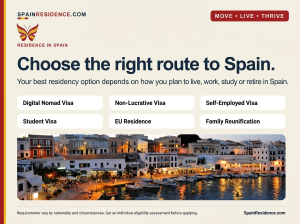
Your Dream of Living in Spain Starts with One Click.
For non-European citizens, the path to Spanish residency can feel like navigating a maze. Between understanding the different visa types, gathering the right documents, and meeting financial requirements, the process is often overwhelming—especially when you’re not sure where to begin.
That’s why we’ve made it simple.
With one click, you can connect with our expert team and get the answers you need to start your journey.
Why One Click?:
Spanish immigration law offers multiple pathways for non-EU citizens, including the Non-Lucrative Residence permit for those with financial independence , the Digital Nomad Visa for remote workers , the Self-Employed Visa for entrepreneurs , and permits for highly qualified professionals and researchers . Each has its own requirements:
- Non-Lucrative: 400% of the IPREM monthly (approx. €2,646/month for the main applicant) in financial resources, private health insurance, and no work activity in Spain.
- Digital Nomad: Remote work for foreign clients (max 20% Spanish income), proof of qualifications or experience, and sufficient financial means.
- Self-Employed: A viable business plan, proof of investment, and licences.
- Entrepreneurs (Law 14/2013): An innovative business project certified by ENISA.
For first-time applicants from abroad, the process always begins at a Spanish consulate in your home country . Once you have your visa and arrive in Spain, you must apply for your TIE (Foreigner Identity Card) within one month .
Choosing the right pathway is critical—applying through the wrong route is one of the most common reasons for refusal.
What Happens When You Click?:
Our immigration consultants, qualified in Spanish law, will:
- Analyse Your Profile: We assess your personal circumstances, financial situation, and professional background.
- Explain Your Options: We provide a clear overview of the residency pathways that best suit you.
- Outline the Requirements: We give you a straightforward breakdown of the documentation and financials needed for your specific case.
Take the First Step—Absolutely No Obligation:
Spanish Prime Minister Pedro Sánchez described the measure as “an act of justice and a necessity,” emphasising that people already living and working in Spain should do so under equal conditions and pay taxes .
The reform is not just about regularisation—it represents a fundamental shift in Spain’s approach to immigration. With an ageing population and demographic challenges ahead, the government has recognised that new inflows of migrants are necessary for the economy and to support the social security system .
Residencies available in Spain:
- Digital-Nomad visa Spain (Remote worker in Spain)
- Non-Lucrative Visa Spain (Spanish visa non lucrative)
- Student-Visa Permit (Student-Visa & up-to 30 hours work per week)
- Self-Employed Visa Spain (Self employed expats in Spain)
- All Visa-Categories in Spain (SEE-ALL here; Arraigo, Special Cases, etc.)
Immigration procedures and immigration regulations change regularly, and it is crucial to stay updated with the most recent information from a reliable source. If you have any questions or concerns about your situation, we advise to consult an immigration authority or legal professional who specializes in immigration matters.
We offer Spanish Residence Services and can assist you with most Spanish legal processes.
Permanent residency is permitted after 5 years of Temporary Spanish Residency through Digital-Nomad, Non-Lucrative, Student-Visa or Self-Employed. This followed by 5 years of permanent residency in Spain and permits Spanish Citizenship applications to obtain a Spanish Passport.