Which Residence in Spain is Correct for Me?
Can I work on a non-lucrative visa in Spain?
What is the difference between Spanish residency and citizenship.
How to Know Which Spanish Residency Fits You.
You want to move to Spain. But a quick Google search throws up three popular options: the Non‑Lucrative Visa, the Digital Nomad Visa, and the Self-Employed Visa. They sound similar, yet each leads to a very different type of application, lifestyle, tax bill, and renewal process.
So which one is actually right for you? The answer depends on three things: how you earn money, how much savings you have, and what you plan to do once you arrive.
At SpainResidence.com, we help clients match their profile to the right permit—saving months of wasted effort. Let’s break it down.
The Non‑Lucrative Visa (NLV) – For retirees & passive income earners:
You are a good fit if:
- You do not need to work in Spain (remotely or locally).
- You have steady passive income: pensions, rental income, dividends, or substantial savings.
- You want to live in Spain full‑time (more than 183 days per year)—though this requirement has been removed for 2026.
The non lucrative residence visa Spain is one of the most popular pathways for those seeking a non-working residence visa Spain. This Spain non-lucrative residence visa allows you to enjoy life in Spain without engaging in any professional activity.
Key requirements:
- Prove monthly income of €2,400+ (€28,800 per year) for the main applicant, with additional funds for family members.
- Obtain private health insurance with no co‑pay.
- No criminal record.
- Have suitable accommodation in Spain.
The Spanish non lucrative residence visa requirements are straightforward for those with sufficient passive income. For anyone wondering how to get residence permit in Spain without working, the non-lucrative residence permit Spain is the answer.
The catch: You cannot work at all (not even remotely for a foreign employer). This is a strict non-working (non-lucrative) residence visa Spain—unlike the Digital Nomad Visa which permits remote work. You also previously needed to live in Spain for most of the year, though this 183-day requirement has been removed in 2026, making the non-lucrative visa and residence permit Spain more flexible than ever.
Best for: Retirees, real estate investors with passive income, or anyone who has saved enough to stop working. This non profit residence Spain option is ideal for those with financial independence.
Pathway to permanent residency: After 5 years of holding this Spain residence visa (non-lucrative), you can apply for Spain permanent residence—the same residence permit Spain available to other routes. After 10 years, you may be eligible for Spanish citizenship.
The Digital Nomad Visa (DNV) – For remote workers & freelancers:
You are a good fit if:
- You work remotely for a company outside Spain (or as a freelancer with foreign clients).
- You can prove at least 3 months of remote work history.
- You want to keep earning while enjoying Spanish life.
Key requirements:
- Show proof of remote employment or freelance contracts.
- Minimum income: €2,849 per month for 2026 (200% of Spain’s minimum wage).
- No more than 20% of your income may come from Spanish clients.
The catch: You will pay Spanish income tax, but under a special reduced rate (15‑24% for the first 4 years). You also need to register as a freelancer (autónomo) in some cases.
Best for: Tech workers, online consultants, creators, and freelancers who want legal residency without giving up their current job. Unlike the non lucrative residence visa Spain, this permit allows you to work actively.
For those comparing the Spain non-lucrative residence visa against the Digital Nomad Visa, the key difference is activity: the NLV prohibits work entirely, while the DNV permits remote work. Both offer paths to Spain permanent residence after 5 years.
Self-Employed Visa – To Start Your Own Business in Spain:
You are a good fit if:
- You want to offer freelance or consulting services to Spanish clients.
- You plan to open a small business in Spain (shop, restaurant, online store, etc.).
- Your professional activity is tied to the Spanish economy.
Key requirements:
- A viable and realistic business plan (the central element of your application).
- Proof of investment capital to cover business start‑up costs (€5,000–€10,000+ for service‑based activities; €20,000–€30,000+ for physical premises).
- Evidence of sufficient living expenses for the first year (minimum ~€7,200, but €10,000–€15,000 recommended).
- Relevant professional qualifications or proven experience in your field.
- Private health insurance and a clean criminal record.
The catch: You must apply from your home country’s Spanish consulate (not from within Spain, unless you already hold another valid residency permit). Processing takes 1–3 months. Once approved, you must register as autónomo with Social Security and pay monthly contributions (~€80–€300 starting with the reduced tarifa plana).
Best for: Freelancers with Spanish clients, small business owners, consultants, tradespeople, and digital entrepreneurs who want to build a local client base in Spain.
This route differs from the non lucrative residence visa Spain as it permits active work within Spain. It also differs from the Digital Nomad Visa, which is designed for foreign clients rather than the Spanish market.
Work Visa (Cuenta Ajena) – For employees with a Spanish job offer:
You are a good fit if:
- A Spanish company has offered you a job.
- They are willing to sponsor your visa.
The catch: This is the hardest to get because the employer must prove no EU citizen could fill the role. Processing takes 3‑6 months.
Best for: Specialized professionals (engineers, healthcare, IT) with a signed Spanish contract.
(At SpainResidence.com, we focus on the first three visas unless you already have a job offer.)
For those who already hold a Spain residence permit or temporary residence permit Spain under another category, switching to this route may be possible under certain circumstances.
Quick Comparison: Which Visa Is Right for You?:
| Your Situation | Best Option |
|---|---|
| You have passive income and don’t need to work | Non‑Lucrative Visa |
| You want to freelance or open a small business for Spanish clients | Self‑Employment Visa (Autónomo) |
| You work remotely for foreign clients (max 20% Spanish) | Digital Nomad Visa |
| You have a Spanish job offer | Work Visa (Cuenta Ajena) |
Overview of residencies available in Spain:
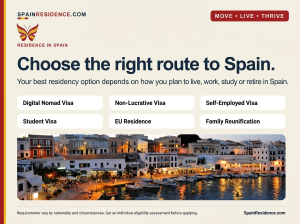
- Digital-Nomad visa Spain (Remote worker in Spain)
- Non-Lucrative Visa Spain (Spanish visa non lucrative)
- Student-Visa Permit (Student-Visa & up-to 30 hours work per week)
- Self-Employed Visa Spain (Self employed expats in Spain)
- All Visa-Categories in Spain (SEE-ALL here; Arraigo, Special Cases, etc.)
Immigration procedures and immigration regulations change regularly, and it is crucial to stay updated with the most recent information from a reliable source. If you have any questions or concerns about your situation, we advise to consult an immigration authority or legal professional who specializes in immigration matters.
We offer Spanish Residence Services and can assist you with most Spanish legal processes.
Permanent residency is permitted after 5 years of Temporary Spanish Residency through Digital-Nomad, Non-Lucrative, Student-Visa or Self-Employed. This followed by 5 years of permanent residency in Spain and permits Spanish Citizenship applications to obtain a Spanish Passport.